
Headless CMS · Next.js
Headless Salesforce CMS + Next.js
A headless architecture that separates Salesforce CMS content from a Next.js, React and TypeScript frontend, with SSR, SSG and API caching.
Next.jsReactTypeScriptSalesforce APIsREST APIsNode.jsSSRSSG
Industry: Enterprise & Digital Services
Decoupled content and frontend, ready for every channel
Project overview
A growing enterprise wanted to modernize by moving to a headless architecture with content reusable across channels.
The problem
- Traditional CMS architecture restricted frontend flexibility.
- Content delivery was tightly coupled with website presentation.
- Difficulties maintaining consistent content across multiple channels.
- Performance limitations on content-heavy pages.
- Limited frontend customization.
- Need for scalable content delivery infrastructure.
- Complex content retrieval and API management.
Solution
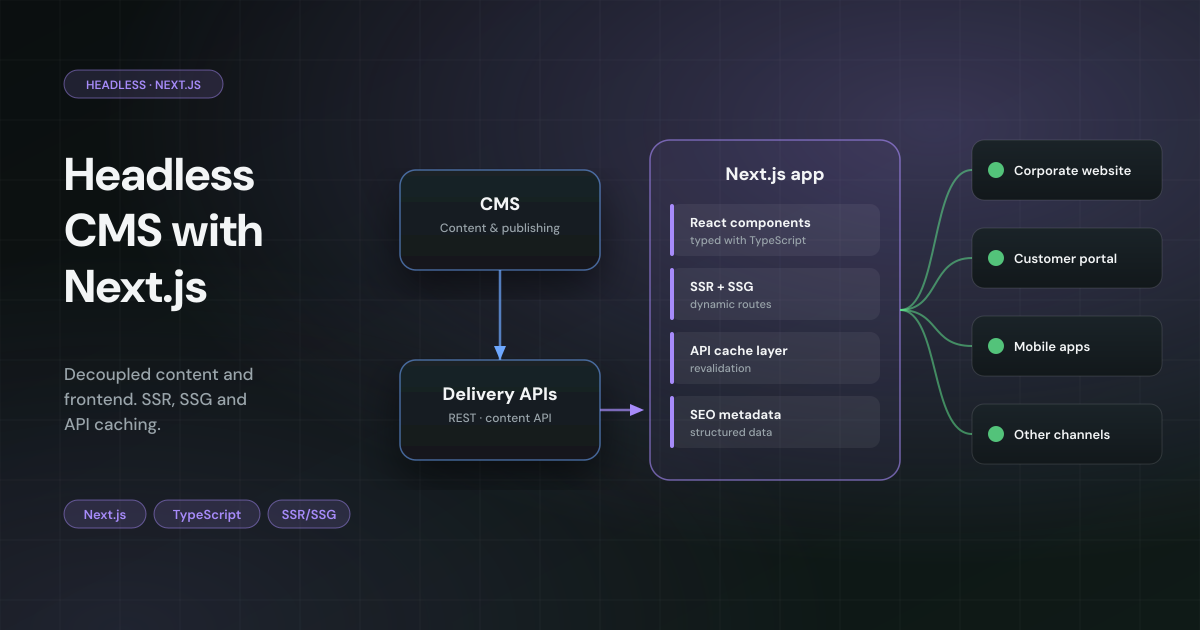
Salesforce CMS handles content creation and management, while Next.js consumes published content through Salesforce content delivery APIs.
Technical implementation
- Salesforce CMS configuration and content modeling.
- Headless content delivery API integration.
- Next.js frontend architecture using React and TypeScript.
- Reusable frontend components for dynamic content rendering.
- Server-side rendering (SSR) and static site generation (SSG).
- API-driven content retrieval and caching.
- Dynamic routing for content pages.
- SEO metadata and structured data implementation.
- Responsive frontend for desktop, tablet and mobile.
- API error handling and optimization.
- Deployment configuration and performance optimization.
Architecture
- Salesforce CMS: content management and publishing
- Salesforce Content Delivery APIs: REST integration
- Next.js application: React components, SSR, SSG, API caching
- Digital experiences: corporate website, customer portal, mobile applications and other channels
Outcome
- Decoupled content management and frontend development.
- Greater flexibility for frontend customization.
- Reusable content delivery across digital channels.
- Improved opportunities for performance optimization.
- More scalable and maintainable digital infrastructure.
- Simplified frontend development and deployment workflows.
- Better foundation for omnichannel digital experiences.
What we measure
Core Web Vitals, API response time, page rendering time, content delivery reliability and development cycle time.
Related service
Headless Salesforce CMS with Next.js →